Every single body of water – from the creek in your backyard to the raging river miles downstream – is connected.
Those small, often overlooked forest water sources are the hidden infrastructure of healthy watersheds. They support biodiversity, safeguard drinking water, strengthen local economies, and help surrounding communities and ecosystems secure one of their most critical resources: safe and reliable water.
Forest carbon projects have emerged as one of the most effective ways to protect these watersheds that communities and businesses depend on. Nowhere is that more evident than in the southeast U.S., where healthy working forests support both local economies and one of the country’s most important water systems.
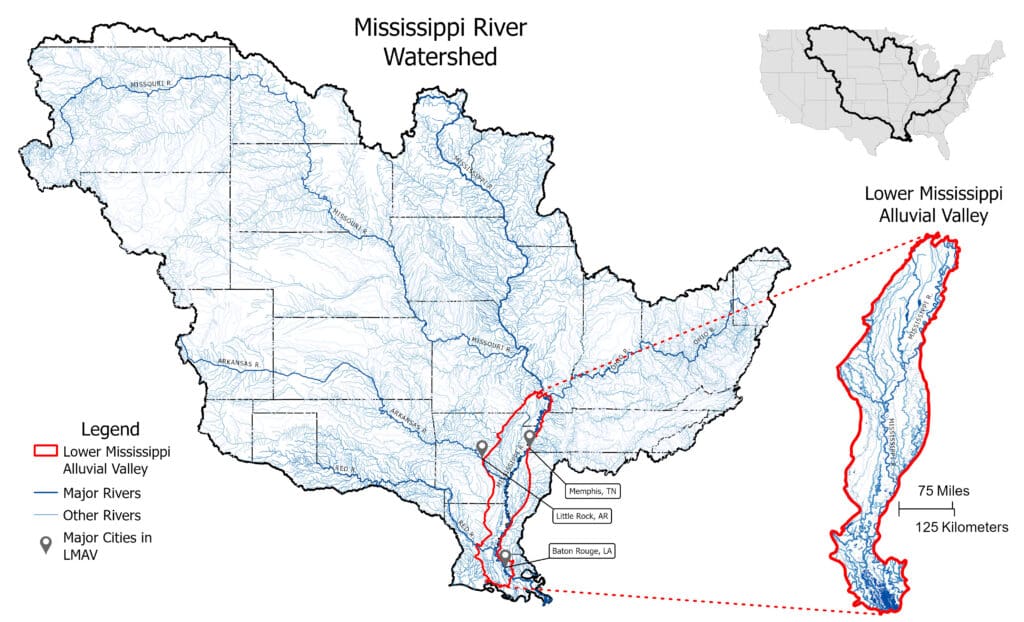
NativState’s core operations are rooted in the southeast timber basket of the U.S, which supplies more than half of the nation’s forest products. That region is also home to the Mississippi Alluvial Plain part of the largest floodplain in the United States spanning over 24 million acres across Illinois, Missouri, Kentucky, Tennessee, Arkansas, Mississippi, and Louisiana.
Approximately 30% of NativState projects are within the Mississippi Alluvial Plain, but all of our projects feed and eventually flow into the Mississippi Alluvial Plain and Gulf Coast, filtering water for downstream populations and supporting biodiversity.
This means we operate not only in one of the country’s most active working forest regions where harvest pressure is real, but also within one of America’s most important regions for water health and security.
Why Forests Are Critical Water Infrastructure
The connection between forests and water isn’t always obvious, but it’s fundamental.
- Approximately 80% of the freshwater in the United States originates from forested watersheds.¹ This means forests provide the clean drinking water relied upon by up to 180 million Americans in over 68,000 communities.²
- National forests alone supply municipal water to over 60 million people in 3,400 communities in 33 States.³
- Small water bodies in forests connect to larger ones through surface streams, shallow groundwater, and storm runoff. These pathways move water, nutrients, and organic matter from tiny forest pools and headwater streams down into big rivers and lakes.
- Businesses rely on current and future water sources for long-term sustainability and survival. Industry and manufacturing account for roughly 20% of global freshwater withdrawals, but usage varies dramatically by sector: standard offices use 15–20 gallons per person per day, while a single large data center can require 3–5 million gallons daily just for cooling.⁴
Small forest water systems play a critical role that no large river can fulfill on its own: they filter pollutants before they reach downstream waters where large populations dwell and regulate water temperatures that fish and other aquatic life depend on. They must remain intact and healthy, rather than broken up by harvest or land development.
They are the essential mechanism by which winter rain can become the seasonal flooding that fills sloughs, sustains forests, and puts leaves, twigs, and insects — the foundation of the food web — within reach of wildlife. Without intact headwaters feeding the system, the larger rivers downstream have no reliable recharge, no filtration, and no thermal regulation.
Healthy forests serve as critical natural infrastructure for healthy water systems, slowing runoff and letting rainfall soak in, helping sustain the recharge that keeps aquifers viable.
How Policy Turned These Forests into Farms in the Mississippi Alluvial Plain
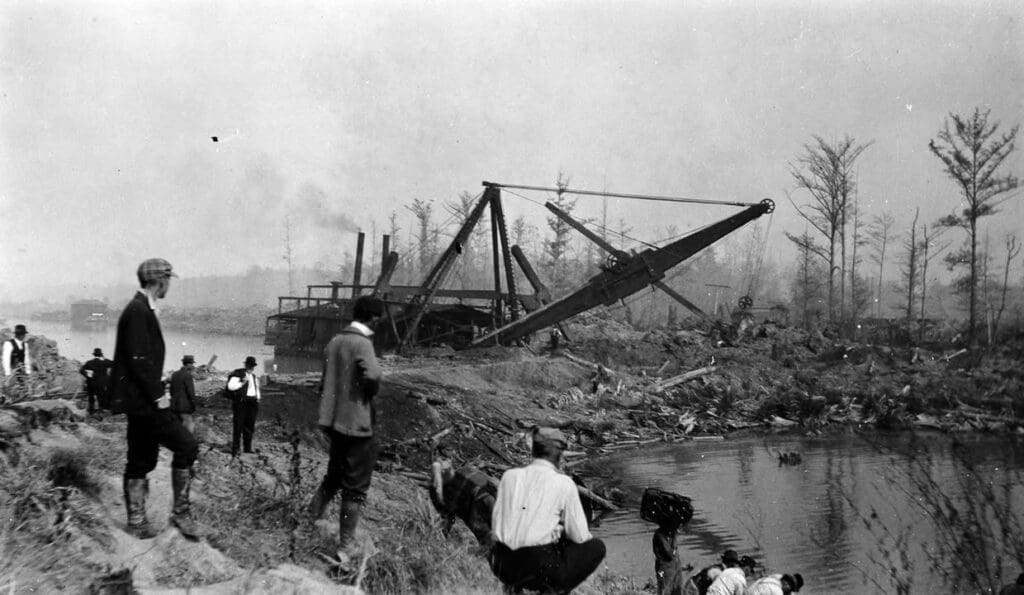
Clearing the land post 1927 flood. Photo Courtesy of Missouri St. Archives.
Federal flood control in the 1920s made forestland farmable, subsidies made clearing it profitable⁶ , and a 1970s commodity boom made it irresistible.⁷ By the time the 1985 Farm Bill removed those incentives, crop prices had permanently outpaced timber and 80% of the Mississippi Alluvial Plain’s bottomland hardwood forests — 24.7 million acres reduced to 5.2 million — with measurable consequences: species extinctions, disrupted fish populations, and declining water quality.⁸/⁹ But hope for forest protection and restoration was not lost. Forests have been coming back ever since, and we have a chance to continue supporting growth and the benefits they provide.
The connection between sustainably managed forests and watershed health has real-world implications, particularly for the communities and businesses operating across the Mississippi Alluvial Plain today.
Cities within the Mississippi Alluvial Plain footprint — including Memphis, Baton Rouge, and Little Rock — are home to major corporate operations, and data center investment in the region is growing rapidly, with over 58 facilities across Louisiana, Mississippi, and Arkansas alone.
This growth generates significant water demand that will continue to rise for years to come, making forest and watershed protection not just an environmental issue, but an economic one.
The stakes run underground, too. The region leans heavily on groundwater, and more than 12 billion gallons are drawn from the Mississippi River Valley alluvial aquifer every day — mostly for irrigation — even as water levels decline across the Delta of northwest Mississippi and the Cache and Grand Prairie regions of eastern Arkansas.
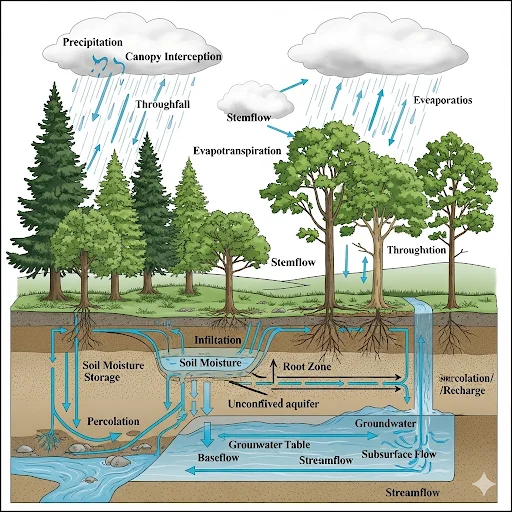
The Hidden Network Keeping Watersheds Alive
In the southeast U.S., over 86% of forestland is privately owned, so the small streams and headwaters embedded in those forests are almost entirely on private land, such as the areas NativState protects through carbon projects, yet most of them never even appear on a single map.⁵
Because they are largely invisible, they are also among the easiest ecosystems to overlook.
Despite their importance, many of these water sources no longer receive the level of federal protection they once did. And that protection matters more today than it did even a few years ago: in its 2023 decision in Sackett v. EPA, the U.S. Supreme Court narrowed the reach of the Clean Water Act, holding that federally protected “waters of the United States” extend only to wetlands with a continuous surface connection to larger, relatively permanent waterways.
Many of the small, isolated, and ephemeral waters at the heart of a healthy watershed now fall outside that federal protection — which makes voluntary, private stewardship more important than ever.
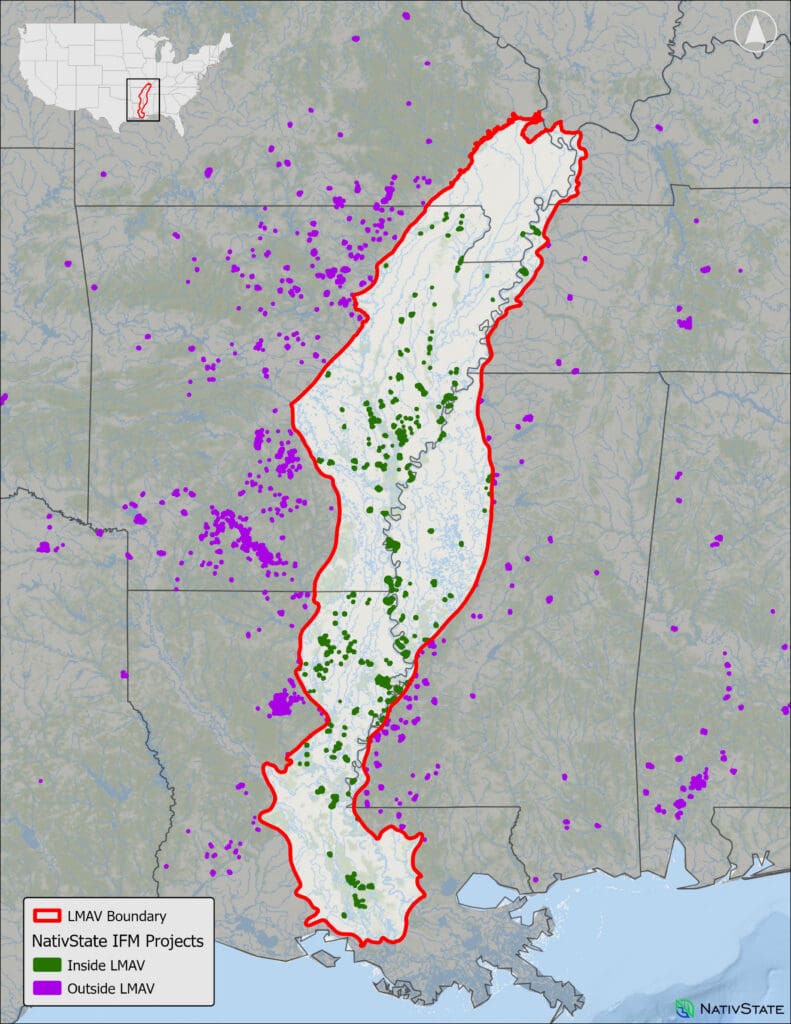
NativState projects protect watersheds that are directly within or eventually flow into the Mississippi Alluvial Plain and Gulf Coast, filtering water for downstream populations and supporting biodiversity.
Reinforcing the Connective Tissue of a Resilient Watershed: NativState’s Mission
As public protections have narrowed, private forest stewardship becomes increasingly critical. That’s where NativState plays an impactful role. By protecting forests – and the water sources within them – we help preserve the natural infrastructure that communities, wildlife, and businesses all depend on.
Since 2021, NativState has:
- Protected over 800,000 acres of critical forestland, including 3,000 miles of streams, and over 30,000 acres of streamside management zones, many of which are located within the Mississippi Alluvial Plain;
- Returned over $30M to landowners enrolled in our forest carbon Improved Forest Management (IFM) program;
- Verified and released over 6M credits.
NativState will continue protecting forests with small landowners through our IFM program, with a goal of 1M acres by the end of 2026, and aims to reforest more than 50K in the Mississippi Alluvial Plain by 2031 through our ARR program. All efforts combined will secure a better future for water, forests and communities.
For small landowners in the southeast U.S., pressure to harvest is a daily reality. Forest carbon projects offer a different path – creating long-term income while conserving the forests and water sources that communities, businesses, and future generations depend on.
In doing so, they help protect the unseen natural infrastructure that keeps entire water systems – and the communities they support – healthy and thriving.
+++
- https://research.fs.usda.gov/treesearch/27348
- https://www.nationalforests.org/article/earth-month-watersheds/
- https://www.fs.usda.gov/managing-land/national-forests-grasslands/water-facts
- U.S. EPA WaterSense, Types of Facilities — Office Buildings, which references the Office Buildings Fact Sheet (EPA, 2017)
- https://southernforests.org/forestry/forests-woods-management/
- Mitsch, W.J. & Gosselink, J.G. Wetlands (Wiley, multiple editions)
- MacDonald, P.O., Frayer, W.E., & Clauser, J.K. (1979). Documentation, Chronology, and Future Projections of Bottomland Hardwood Habitat Losses in the Lower Mississippi Alluvial Plain. U.S. Fish & Wildlife Service.
- Heimlich, R.E., et al. (1998). Wetlands and Agriculture: Private Interests and Public Benefits. USDA Economic Research Service, Agricultural Economic Report No. 765
- https://www.ducks.org/conservation/where-ducks-unlimited-works/mississippi-alluvial-valley